Trike Bike Australia
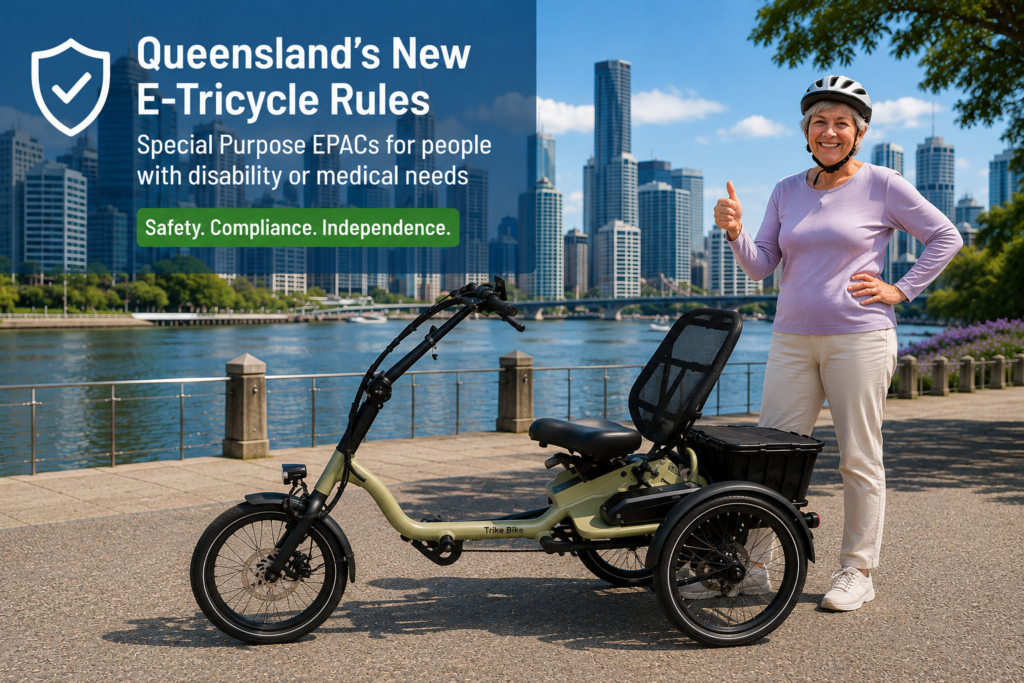
Queensland’s New Electric Tricycle Rules
Hello from Trike Bike Australia,
Queensland introduced major changes to its e-mobility laws from 1 July 2026, including important changes affecting electric tricycles.
For many Australians, an electric tricycle isn’t simply another type of e-bike. For an older rider, a person with limited balance or mobility, or someone living with a disability or medical condition, three wheels can make the difference between being able to ride independently and not riding at all.
Queensland’s new laws now specifically recognise a pathway for non-standard electric tricycles used by older riders and people with a disability or medical condition.
An important change for electric tricycles
The new legislation establishes both Legacy EPAC and Special Purpose EPAC pathways. The Special Purpose EPAC provisions recognise that a conventional two-wheel electric bicycle is not suitable for everybody and provide a framework capable of including electric tricycles.
In our new guide, we explain:
| 1. What is a Special Purpose EPAC? The legislation provides for a vehicle with two or more wheels that is designed or modified to enable an elderly person or a person with a disability or medical condition to ride it. The words “two or more wheels” are particularly important for electric tricycle riders. |
| 2. Why electric tricycles need a different approach. Adult tricycles can provide greater low-speed stability and accommodate low step-through frames, supportive seating, adaptive controls, different riding positions and easier mounting and dismounting. For some riders, these features are the very reason they are able to cycle. |
| 3. Does every electric tricycle automatically qualify? No. The Special Purpose EPAC category does not mean every electric tricycle automatically qualifies for unrestricted public use. Queensland is establishing an E-Bike Assurance Scheme under which eligible non-standard e-bikes can be inspected by an authorised verifier. |
Motor power and speed
Special Purpose does not mean high-speed.
Queensland has made it clear that the Special Purpose tricycle pathway should not be confused with an exemption for high-speed electric bikes.
For standard e-trikes, the Queensland Government currently suggests 500 watts maximum continuous rated power, 25 km/h maximum motor-assisted speed and 25 km/h maximum throttle-only assistance.
Important for NDIS and adaptive tricycle riders
The new legislation expressly recognises vehicles designed or modified to enable an older person or a person with a disability or medical condition to ride. This provides a much clearer legislative framework for adaptive electric tricycles than simply trying to treat every vehicle as an ordinary two-wheel e-bike.
Before buying an electric tricycle
Ask more than “How powerful is it?”
Before purchasing an electric tricycle for use in Queensland, buyers should consider its intended public use, continuous rated motor power, assisted speed, throttle operation, compliance documentation and whether an adaptive or non-standard e-trike could qualify under the Special Purpose EPAC pathway.
Compliance, suitability, safety and after-sales support can be considerably more important than simply comparing advertised motor wattage, maximum speed or battery capacity.
The rules are still developing. Queensland’s Special Purpose EPAC framework has been established in legislation, but some of the detailed verification arrangements are still being implemented.
Trike Bike Australia will continue monitoring these developments and updating our information as the Queensland Government releases further requirements.
Adult Tricycle Specialists Since 2007
At Trike Bike Australia, adult tricycles are our single speciality — we don’t sell anything else. We work with riders, families, carers, occupational therapists, physiotherapists, NDIS participants and aged-care customers to help find tricycles suited to individual requirements.